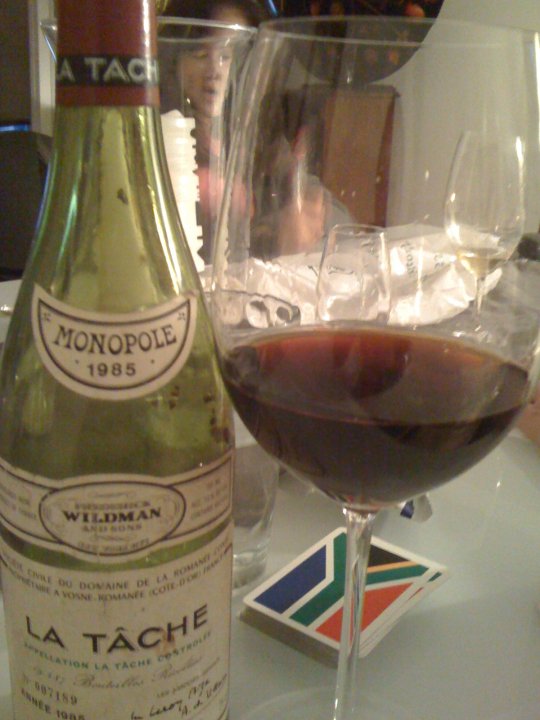
I listed 250 wines that I rated 93 points or more in 2025. I could have listed a few more because I may have overlooked some, and deliberately didn't list everything (main omissions were a couple of bottles of clearly below par high end claret). But looking back it was another memorable year for indulging my wine loving passion, and I count myself as lucky to have encountered so many high calibre wines during an otherwise mixed year.
Of the wines I listed, Bordeaux dominated with 103 (41.2% of the total), followed by (mainly Northern) Rhone 42 (16.8%), then Piedmont 35 (14.0%), Burgundy exactly evenly distributed between reds and whites, 24 (9.6%), with champagne on 13 (5.2%), Loire seven (2.8%), Tuscany, Australia and USA five (2.0%), Germany and NZ three (1.2%), Spain two (0.8%) and one each for Alsace, Jura and Lebanon.
Of the top four, Bordeaux was slightly less than my holdings by volume, 41% vs 51% of my total holdings, as was Piedmont, 14% vs 18.5%, and burgundy, 9.6% vs 14.8%, while Rhone at 16.8% was ten percentage points above my holdings of 6.8% of the total. While it no doubt was a memorable year for Northern Rhone, this was a direct result of the five Northern Rhone-specific, high-end, off lines during the year, at which most of the top producers featured.
But I would say it was a disappointing year for burgundy. Not only did burgundy not compete well at the highest level - I did open quite a few expensive bottles and I did encounter expensive bottles through the generosity of friends - but few really cut the mustard, with the notable exception of two superb bottles of De Montille, a Corton Charlemagne and a Pommard Rugiens, both 95 pts. The biggest disappointment was an Armand Rousseau Chambertin 2002 (88 points). And I opened so many flawed bottles of red burgundy, but I do not recall any premoxed whites thankfully.
Of scoring, revisited
As noted in the opening post, based on a what I think is a representative sample of wines tasted my average score was 91.6, with a standard deviation of 2.9, which implies 68% scored between 88.7 and 94.5 - or a bit under two thirds between 89 and 94. There were so many good wines that I rated 92 - and 91 - that did not make the cut. So in no sense am I inflating scores as some of the critics do these days to grab attention or to curry favour with producers.
During the year I did experiment with a lot with cheaper wines - hence the El cheapo whites from the Wine Society thread on wine-pages - and lot of these helped to drag down the average...especially the TWS Chilean chardonnays! If I was scoring supermarket wines only I would imagine that my average would be around ten points lower.
Only two wines scored 98, and I feel that awarding a wine 100 is somewhat disingenuous because there is always the potential for something better. Bandying around 100 point scores makes a mockery of what is anyway a purely subjective scoring system with, in my opinion, no credible scientific foundation.
For our purposes most of the range of 50-100 is redundant, and I suspect I am typical of my wine drinking peers, with about two thirds of my scores in a five point range with the tails petering out in the high 90s and low-mid 80s respectively.
Top producers by volume in my lists (two or more inclusions)
1/ Bordeaux

2/ Other


No comments:
Post a Comment