
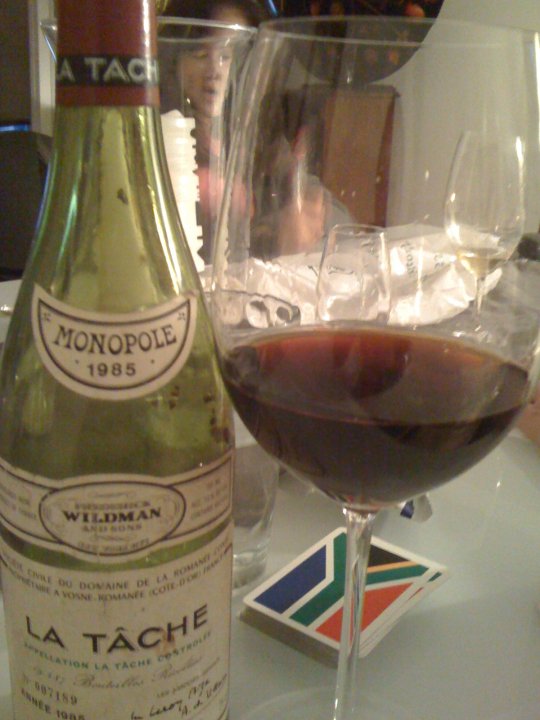
Sunday, 8 May 2011

Wednesday, 4 May 2011
Spanish wines at Kittle House
"You have rats in Barcelona don't you? Or did Franco have them all shot? - Basil Fawlty to Manuel in the Hotel Inspectors, Fawlty Towers 1975
This was the next tasting after the Super Calis went ballistic tasting skillfully organised by Jacques and Pierre who - allegedly - has Robert Parker and Bill Clinton on his speed-dial. Many thanks to both of them for organising a fascinating tasting with lots of good-humoured banter thrown in.
Intro
Lopez De Heredia Blanco 1990 - some yellow brown signs of age, not excessively so, and initial VA. This blew off but the wine tasted a bit tired and was on a slow boat to China. I have had much more vibrant examples.
Flight 1
1973 Lopez de Heredia Vina Tondonia Gran Reserva (Rioja)
This has some interesting fresh balsamico notes and quite an austere streak with some cherries. But rather than firm up it kind of went nowhere though it did evolve in the glass.
1970 Lopez de Heredia Vina Tondonia Gran Reserva (Rioja)
Slightly more interesting with some meaty and gamey notes, but again it was a bit flaccid. We enjoyed much more exhilarating examples of these two last year. Both had mature burgundian and nebbiolo notes but not as much complexity as a great Barolo or Cotes de Nuits this time.
All three Lopez wines were on a slow boat to China. But at this age it is all about good bottles rather than good wines isn’t it? When Jacques and I attended a Lopez tasting early last year these two wines were amazing.

Flight 2
(1985/1991/1996) Vega Sicilia Especiale Riserva (Ribera del Duero)
1991 Vega Sicilia Unico (Ribera del Duero)
Both of these were super and it was hard to pick a winner. Darker maroon, meaty notes, the oak is not fully integrated, but got stronger and stronger in the glass. Need to drink these aged 40+. These are great wines which are not easy to understand. Until I do I hesitate to mention them in the same league as Petrus and Romanee Conti but I could change my mind if I can lay my hands on a ‘28 in San Sebastien.
Now the notes really fall off so just some impressions of the rest.
Flight 3
2005 Bodegas Roda Cirsion (Rioja)
A super modern Rioja
2005 Aalto PS (Ribera del Duero)
Very popular around the table but a bit too extracted and alcoholic for my liking
2007 Hacienda Monasterio (Ribera del Duero)
Very young still and lashings of vanilla oak, needs time to calm down. A monaster (in an eSpanish accent).
Flight 4
2005 Mas Doix Doix (Priorat)
2006 Clos Mogador (Priorat)
2008 Raul Perez Ultreia Valtuille (Bierzo)
The doix doix – pronounced doish-doish was heavy and like having a fight with a grizzly bear, while the Mogador was an ugly monster. The Perez was however refreshingly unmanipulated. But by now I was really struggling (I was jet-lagged as well).
It was a fascinating tasting but I don’t think I could handle another one in San Fran. I am sticking to burgundy.
This was the next tasting after the Super Calis went ballistic tasting skillfully organised by Jacques and Pierre who - allegedly - has Robert Parker and Bill Clinton on his speed-dial. Many thanks to both of them for organising a fascinating tasting with lots of good-humoured banter thrown in.
Intro
Lopez De Heredia Blanco 1990 - some yellow brown signs of age, not excessively so, and initial VA. This blew off but the wine tasted a bit tired and was on a slow boat to China. I have had much more vibrant examples.
Flight 1
1973 Lopez de Heredia Vina Tondonia Gran Reserva (Rioja)
This has some interesting fresh balsamico notes and quite an austere streak with some cherries. But rather than firm up it kind of went nowhere though it did evolve in the glass.
1970 Lopez de Heredia Vina Tondonia Gran Reserva (Rioja)
Slightly more interesting with some meaty and gamey notes, but again it was a bit flaccid. We enjoyed much more exhilarating examples of these two last year. Both had mature burgundian and nebbiolo notes but not as much complexity as a great Barolo or Cotes de Nuits this time.
All three Lopez wines were on a slow boat to China. But at this age it is all about good bottles rather than good wines isn’t it? When Jacques and I attended a Lopez tasting early last year these two wines were amazing.

Flight 2
(1985/1991/1996) Vega Sicilia Especiale Riserva (Ribera del Duero)
1991 Vega Sicilia Unico (Ribera del Duero)
Both of these were super and it was hard to pick a winner. Darker maroon, meaty notes, the oak is not fully integrated, but got stronger and stronger in the glass. Need to drink these aged 40+. These are great wines which are not easy to understand. Until I do I hesitate to mention them in the same league as Petrus and Romanee Conti but I could change my mind if I can lay my hands on a ‘28 in San Sebastien.
Now the notes really fall off so just some impressions of the rest.
Flight 3
2005 Bodegas Roda Cirsion (Rioja)
A super modern Rioja
2005 Aalto PS (Ribera del Duero)
Very popular around the table but a bit too extracted and alcoholic for my liking
2007 Hacienda Monasterio (Ribera del Duero)
Very young still and lashings of vanilla oak, needs time to calm down. A monaster (in an eSpanish accent).
Flight 4
2005 Mas Doix Doix (Priorat)
2006 Clos Mogador (Priorat)
2008 Raul Perez Ultreia Valtuille (Bierzo)
The doix doix – pronounced doish-doish was heavy and like having a fight with a grizzly bear, while the Mogador was an ugly monster. The Perez was however refreshingly unmanipulated. But by now I was really struggling (I was jet-lagged as well).
It was a fascinating tasting but I don’t think I could handle another one in San Fran. I am sticking to burgundy.
Thursday, 28 April 2011
Tournament favourite DRC knocked out in Burgundy Champions League shock
A disparate and diverse bunch of mostly middle-aged men, reflecting the full spectrum of shades of grey, converged on the Ledbury last night, for no particular reason other than being united and mesmerized by their love of fine burgundy. Even before the fashionably late David Wainwright arrived we started on the first flight.
Flight one
Batard-Montrachet Grand Cru, Domaine Marc Morey, 1990
A deep golden – the sort of colour that would set alarms bells ringing if it was younger – and expectations around the table were politely muted. After a slightly dodgy start it began to pull itself together and firm up in the glass. It was fat and buttery but not unfocussed; very rich yet precise and crisp, with tangerine then some licorice at the end.
Chevalier-Montrachet Grand Cru, Domaine Leflaive, 1997
This had a much lighter colour and a more subdued nose, some toastiness and nuttiness, but strangely subdued until one of the sharper palates suggested that it might be corked; if so it was only mildly corked and still drank well with the langoustine.
Angus, Keith and Jon. Luke the sommelier standing

Flight two
DRC Echezeaux 2000
Resplendent bright pinkish-maroon; high-toned, youthful and vibrant primary raspberry fruits dominate; wonderful precision, delineation and superb texture. After a while some gamey notes emerged – hung pheasant. This riveting wine will surely evolve beautifully over the next 20 years.
DRC Romanee Saint Vivant 1994 – flawed not tasted
DRC La Tache 1967
A healthy dark maroon this 44 year old was still very much in the land of the living. However, it had gone off on multiple tangents a long time ago. Decadent bordering on malodorous with tertiary notes of game, meat, minerals, damp undergrowth, rotting fruit, carcasses, molasses and brown sugar. Eventually it began to fade in the glass.
Nigel, David and Ken (foreground)

Flight three
Domaine Armand Rousseau Gevrey Chambertin Clos Saint Jacques 1992
This was introduced into the mix after the RSV dropped out. Hung gamey notes, savoury texture, leanish and elegant on the palate; fine and feminine but somewhat shy and angular (compared to what followed). A pretty Audrey Hepburn of a wine.
Domaine Armand Rousseau Gevrey Chambertin Clos-Saint-Jacques 1989
More developed rounder and fuller, this had decadent strawberries to match the pervasive gaminess. Spicey, fruity and silky with an hourglass figure. Much as I liked the 1992 I adored this a lot more.
Ken Lamb, Angus and Keith

Domaine Armand Rousseau Chambertin 1996
This wine was more opaque, denser, brooding and powerful than the previous two, and clearly it has a long way to evolve to reach its plateau. It had a smorgasbord of spices, strawberries, gamey, camphor and other minerally notes. Full-bodied and long, it is a thrilling and spectacular wine.
Domaine Armand Rousseau Chambertin 1988
A very good wine which just suffered by comparison with the 1996 – should have tried it first. It had a sweet spicey nose and a good texture, but lacked the focus and precision of the 1996, which made it difficult to analyse. On its own you would be very happy with it.
Jon and Nigel with Luke pouring

Flight Four
DRC Richebourg 1992 – flawed – so in its place:
Armand Rousseau Chambertin Clos De Beze 1995
Big brooding and powerful, the texture was not quite as smooth as the 1996 Chambertin, and it clearly also needs a good deal of time. This had good berry fruit, with tertiary/smokey-bonfire/forest floor nuances beginning to emerge and a spectacular complex and luxurious finish.
DRC Richebourg 2000
Pure vibrant, lazer sharp focus, very primary and not dissimilar to the Echezeaux; some meaty, gamey and minerally notes were lurking and eventually came through but this needs a lot of time. Didn’t quite make the earth move beneath my feet the way it did in 2009 but like its sibling it has a fine future ahead.
David posing with the night's trophies

Flight five
Ch Coutet 1971
An effusive burnt orange with notes of marmalade, citrus – it was matched up against crème brulee with orange and cardamom, probably the best dessert I have ever tried. The Coutet being a Barsac is probably better suited to foie gras, and sauternes would have been a better match, but still a suitably high note on which to end festivities.
My wine of the night was the 96 Chambertin followed by the 95 Clos De Beze, but if I could choose one to drink now it would be the 1989 CSJ.
Thanks to Nigel and his staff for another sublime culinary tour de force and also to Ken, Angus, Keith, Jon, David and Ken for a fabulous evening.
The menu

Flight one
Batard-Montrachet Grand Cru, Domaine Marc Morey, 1990
A deep golden – the sort of colour that would set alarms bells ringing if it was younger – and expectations around the table were politely muted. After a slightly dodgy start it began to pull itself together and firm up in the glass. It was fat and buttery but not unfocussed; very rich yet precise and crisp, with tangerine then some licorice at the end.
Chevalier-Montrachet Grand Cru, Domaine Leflaive, 1997
This had a much lighter colour and a more subdued nose, some toastiness and nuttiness, but strangely subdued until one of the sharper palates suggested that it might be corked; if so it was only mildly corked and still drank well with the langoustine.
Angus, Keith and Jon. Luke the sommelier standing

Flight two
DRC Echezeaux 2000
Resplendent bright pinkish-maroon; high-toned, youthful and vibrant primary raspberry fruits dominate; wonderful precision, delineation and superb texture. After a while some gamey notes emerged – hung pheasant. This riveting wine will surely evolve beautifully over the next 20 years.
DRC Romanee Saint Vivant 1994 – flawed not tasted
DRC La Tache 1967
A healthy dark maroon this 44 year old was still very much in the land of the living. However, it had gone off on multiple tangents a long time ago. Decadent bordering on malodorous with tertiary notes of game, meat, minerals, damp undergrowth, rotting fruit, carcasses, molasses and brown sugar. Eventually it began to fade in the glass.
Nigel, David and Ken (foreground)

Flight three
Domaine Armand Rousseau Gevrey Chambertin Clos Saint Jacques 1992
This was introduced into the mix after the RSV dropped out. Hung gamey notes, savoury texture, leanish and elegant on the palate; fine and feminine but somewhat shy and angular (compared to what followed). A pretty Audrey Hepburn of a wine.
Domaine Armand Rousseau Gevrey Chambertin Clos-Saint-Jacques 1989
More developed rounder and fuller, this had decadent strawberries to match the pervasive gaminess. Spicey, fruity and silky with an hourglass figure. Much as I liked the 1992 I adored this a lot more.
Ken Lamb, Angus and Keith

Domaine Armand Rousseau Chambertin 1996
This wine was more opaque, denser, brooding and powerful than the previous two, and clearly it has a long way to evolve to reach its plateau. It had a smorgasbord of spices, strawberries, gamey, camphor and other minerally notes. Full-bodied and long, it is a thrilling and spectacular wine.
Domaine Armand Rousseau Chambertin 1988
A very good wine which just suffered by comparison with the 1996 – should have tried it first. It had a sweet spicey nose and a good texture, but lacked the focus and precision of the 1996, which made it difficult to analyse. On its own you would be very happy with it.
Jon and Nigel with Luke pouring

Flight Four
DRC Richebourg 1992 – flawed – so in its place:
Armand Rousseau Chambertin Clos De Beze 1995
Big brooding and powerful, the texture was not quite as smooth as the 1996 Chambertin, and it clearly also needs a good deal of time. This had good berry fruit, with tertiary/smokey-bonfire/forest floor nuances beginning to emerge and a spectacular complex and luxurious finish.
DRC Richebourg 2000
Pure vibrant, lazer sharp focus, very primary and not dissimilar to the Echezeaux; some meaty, gamey and minerally notes were lurking and eventually came through but this needs a lot of time. Didn’t quite make the earth move beneath my feet the way it did in 2009 but like its sibling it has a fine future ahead.
David posing with the night's trophies

Flight five
Ch Coutet 1971
An effusive burnt orange with notes of marmalade, citrus – it was matched up against crème brulee with orange and cardamom, probably the best dessert I have ever tried. The Coutet being a Barsac is probably better suited to foie gras, and sauternes would have been a better match, but still a suitably high note on which to end festivities.
My wine of the night was the 96 Chambertin followed by the 95 Clos De Beze, but if I could choose one to drink now it would be the 1989 CSJ.
Thanks to Nigel and his staff for another sublime culinary tour de force and also to Ken, Angus, Keith, Jon, David and Ken for a fabulous evening.
The menu

Sunday, 3 April 2011
Wines of the week
Jean Boillot Volnay 1er Cru Les Freimets, 2001 and Chateau Bourgneuf (Pomerol) 1990
The Volnay was wonderfully long and complex with barnyard and chocolately notes on the finish; it was quite ready to go and absolutely delicious. Unfortunately I can't source any more...
The Bourgneuf was young and ever so silky and refined; remarkably youthful actually but not inaccessible. It was about $60 and more than worth it; I think the Volnay was $50...ish and worth it too.
Apologies for the squint, Leaning Tower of Pisa, picture:

The Volnay was wonderfully long and complex with barnyard and chocolately notes on the finish; it was quite ready to go and absolutely delicious. Unfortunately I can't source any more...
The Bourgneuf was young and ever so silky and refined; remarkably youthful actually but not inaccessible. It was about $60 and more than worth it; I think the Volnay was $50...ish and worth it too.
Apologies for the squint, Leaning Tower of Pisa, picture:

Monday, 28 March 2011
Wines of the week
I will start with a photo:

So the two barolos were drunk at my favourite Manhattan restaurant - Fabio Piccolo Fiore with friend Sandy - a connoisseur and a sage who brought the Marchesi Barolo 1958. I think I will award the Marchesi the wine of the week - I mean it just has the coolest label doesn't it?

But the Bruno Giacosa Barolo Collina Rionda Riserva 1990 is pretty close to perfection in barolo and one of the best five I barolos/barbarescos I have ever drunk.*
The Giacosa had some ethereal strawberry notes then truffle, tar, and super complexity, power, length and balance. It was drinking well for such a young wine (it is only 21 after all, unlike most 21-year olds it was grown up).
Rather than fade or do a shooting star impersonation the Marchesi went from strength to strength, with some faint notes of roses, tar and smoke, then dark chocolate notes and a fine length. A lively and vibrant 1958. A privilege to drink.
The Guigal Cote Rotie La Turque 1987, drank on Saturday was frankly a bit of a porn star. In some respects it was very good, with the beguiling bacon fat being the most alluring trait, allied to that La Turque 'kinkiness' - but I don't think this wine - the 1987 - needs 36 months in new oak! It was too oaky and frankly on the young side. I had the 1985 a few years ago and it was very young - it mauled a 1981 Penfolds Grange - like a Cyborg killer it shows no mercy nor remorse - not tried the 1986 but I doubt any La Turque is ready! My least favourite of the La-Las, but always fun to drink (because lest face it, it is not ever going to be boring).
* Others are:
- Bruno Giacosa Barbaresco Santo Stefano Riserva 1974
- Gaja Barbaresco Sori San Lorenzo 1971
- Giacomo Conterno Barolo Monfortino 1990
- Franceso Rinaldi Barolo Riserva 1961

So the two barolos were drunk at my favourite Manhattan restaurant - Fabio Piccolo Fiore with friend Sandy - a connoisseur and a sage who brought the Marchesi Barolo 1958. I think I will award the Marchesi the wine of the week - I mean it just has the coolest label doesn't it?
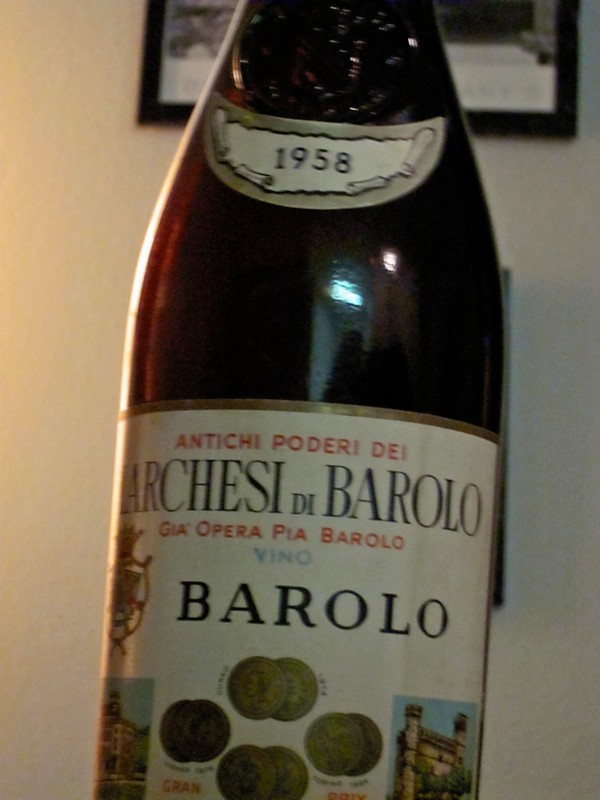
But the Bruno Giacosa Barolo Collina Rionda Riserva 1990 is pretty close to perfection in barolo and one of the best five I barolos/barbarescos I have ever drunk.*
The Giacosa had some ethereal strawberry notes then truffle, tar, and super complexity, power, length and balance. It was drinking well for such a young wine (it is only 21 after all, unlike most 21-year olds it was grown up).
Rather than fade or do a shooting star impersonation the Marchesi went from strength to strength, with some faint notes of roses, tar and smoke, then dark chocolate notes and a fine length. A lively and vibrant 1958. A privilege to drink.
The Guigal Cote Rotie La Turque 1987, drank on Saturday was frankly a bit of a porn star. In some respects it was very good, with the beguiling bacon fat being the most alluring trait, allied to that La Turque 'kinkiness' - but I don't think this wine - the 1987 - needs 36 months in new oak! It was too oaky and frankly on the young side. I had the 1985 a few years ago and it was very young - it mauled a 1981 Penfolds Grange - like a Cyborg killer it shows no mercy nor remorse - not tried the 1986 but I doubt any La Turque is ready! My least favourite of the La-Las, but always fun to drink (because lest face it, it is not ever going to be boring).
* Others are:
- Bruno Giacosa Barbaresco Santo Stefano Riserva 1974
- Gaja Barbaresco Sori San Lorenzo 1971
- Giacomo Conterno Barolo Monfortino 1990
- Franceso Rinaldi Barolo Riserva 1961
Tuesday, 22 March 2011
(All we hear is) Radio Coteau
Last night John Dawson (Jnr. Aka Jackdaw) and his wife Amanda generously hosted a wine tasting dinner in CT with Eric Sussman the winemaker from Radio Coteau winery on the northern coast of California. What a cool name…when I first heard it, for some bizarre reason the 1984 Queen song immediately came flooding into my head:
All we hear is Radio ga ga - Radio goo goo - Radio ga ga
All we hear is Radio ga ga - Radio blah blah
What it actually means is this:
Radio-Coteau (rā’ dē ō - kō tō’) adj. A colloquial expression suggesting ‘word of mouth.’ Region: Northern Rhone. Literal Translation: broadcasting from the hillside.
Eric first heard the expression radio coteau from a friend while living and working in Burgundy. He worked at the renowned estate Comte Armand and previous to that did a spell at Chateau Mouton Rothschild.
According to the blurb:
“Radio-Coteau works closely with select cool-climate coastal vineyard sites in Western Sonoma County and Anderson Valley emphasizing sustainable viticulture in conjunction with a natural, non-interventionist approach in the cellar to more accurately reflect the unique character of each site and season.”
According to Robert Parker:
“Proprietor Eric Sussman seems to go from strength to strength at this small boutique winery. One of the buzz words in the wine world is - natural- winemaking, which has no real definition and is often shamelessly used to promote a certain style of wine. Yet Radio-Coteau is a great example of 'natural winemaking' native indigenous fermentations, incredibly low usage of SO2 and biodynamically farmed vineyards.
We tried the 2005 and 2006 Savoy Chardonnays and did a vertical of the Savoy Pinot Noir from 2002 to 2007. The current releases, which we didn’t try, are the 2009s, which sell for $48 a bottle – well into burgundy territory, so we lined up a few burgs to provide a reference point.
Chardonnay Savoy 2005, 2006 (14.4% ABV)
The chardonnays had a clear bright, light, color with a muted nose with hints of pears, white peaches and minerals. They had a thick viscous texture and cool, languid, cocooned feel to them, as if they had recently been bottled. You could be lured into thinking that you are really drinking something special (like an Aubert) here, but when you analyze them, the wines lacked neither sufficient balancing acidity nor tannic spine. Neither are they particularly complex; just somewhat one dimensional, anodyne and lacking in zest and verve. A bit soporific. Don’t get me wrong these are not bad wines – and I would happily drink them if served them - but at the price point you would wish for a more a bit more poise and pizzazz. You don’t get the sense that these wines will improve; they just seem to be on a slow boat to China.

For reference we opened up a Marc Morey Batard-Montrachet 1990 – perhaps a little unfair, but as well as a lot more age, it had a lot more nuanced complexity, terroir and dimensions to its personality. Though fat and buttery it was much better balanced than the Radios, much more interesting and ultimately much more enjoyable.
Pinot Noir Savoy 2002-07
We tried six vintages starting with 2002 and working our way up. The wines had an alluring spicey cherry fruit attack, but the more mature wines also suffered from a deficit of balancing acidity and grip. A little bit stewed. As we worked our way up the wines got better and the 2007 had a nice tannic grip and a bit more backbone than the others. I enjoyed it the most. But similar conclusions applied to pinots as to the chardonnays. For the price these are somewhat bland and one dimensional wines. Footnote: However I like them more than Oregon St-Innocent 2008 pinot noir (Momtazi Vineyard) I am sipping on now.

We tried a couple of red burgundies which brought these deficiencies into clearer focus. A Marquis D’Angerville Volnays Champans 2007 was bright and snappy (antithesis of ‘soporific’) and had a lot more mineral complexity, terroir and finesse. Drinking really well I must say, but it had more verve and vim, more ‘je ne sais quoi?’ Then John served a Ramphet Clos De La Roche 2006, which was delicious, complex, nuanced, perfectly poised and improved over the night. It was the star red wine of the night.
Conclusions
I did enjoy tasting the Radio Coteau wines and they are a lot better than the majority of Californian chardonnays and pinots I have tried but they fall below the benchmark set by good burgundy. The key missing ingredients are (1) balance/ poise (balancing acidity), (2) finesse and complexity (3) elegance and refinement which he tries for but gets blandness instead (i.e., falls between two stools) (4) zest and verve and (4) an expression of ‘terroir.’
I have little doubt that Eric Sussman is going to be highly successful in this venture because he has hardly put a foot wrong. Laid back, softly spoken and personable, he has employed slick marketing – check out the website – and has cultivated an image as ‘hands off’ winemaker, nevertheless producing ‘handcrafted’ wines with minimal interference with nature’s course. Given the very low output and the snappy name and in vogue marketing, this estate easily lends itself to evolving into a cult winery where everyone wants to be on the mailing list. Perhaps most importantly he has received glowing accolades from Robert Parker – after all his opinion matters most – (and other lesser critics), though as yet only scores in the low 90s from HWSRN. The cynic in me would be wary of the herd mentality often associated with allegedly cult wines, or ‘boutique” wineries, but my impression is that these wines are getting better with each vintage. I am not a buyer at the current price point. I might be interested below $30, but I would like to circle back and look at Eric’s progress in five years.
All we hear is Radio ga ga - Radio goo goo - Radio ga ga
All we hear is Radio ga ga - Radio blah blah
What it actually means is this:
Radio-Coteau (rā’ dē ō - kō tō’) adj. A colloquial expression suggesting ‘word of mouth.’ Region: Northern Rhone. Literal Translation: broadcasting from the hillside.
Eric first heard the expression radio coteau from a friend while living and working in Burgundy. He worked at the renowned estate Comte Armand and previous to that did a spell at Chateau Mouton Rothschild.
According to the blurb:
“Radio-Coteau works closely with select cool-climate coastal vineyard sites in Western Sonoma County and Anderson Valley emphasizing sustainable viticulture in conjunction with a natural, non-interventionist approach in the cellar to more accurately reflect the unique character of each site and season.”
According to Robert Parker:
“Proprietor Eric Sussman seems to go from strength to strength at this small boutique winery. One of the buzz words in the wine world is - natural- winemaking, which has no real definition and is often shamelessly used to promote a certain style of wine. Yet Radio-Coteau is a great example of 'natural winemaking' native indigenous fermentations, incredibly low usage of SO2 and biodynamically farmed vineyards.
We tried the 2005 and 2006 Savoy Chardonnays and did a vertical of the Savoy Pinot Noir from 2002 to 2007. The current releases, which we didn’t try, are the 2009s, which sell for $48 a bottle – well into burgundy territory, so we lined up a few burgs to provide a reference point.
Chardonnay Savoy 2005, 2006 (14.4% ABV)
The chardonnays had a clear bright, light, color with a muted nose with hints of pears, white peaches and minerals. They had a thick viscous texture and cool, languid, cocooned feel to them, as if they had recently been bottled. You could be lured into thinking that you are really drinking something special (like an Aubert) here, but when you analyze them, the wines lacked neither sufficient balancing acidity nor tannic spine. Neither are they particularly complex; just somewhat one dimensional, anodyne and lacking in zest and verve. A bit soporific. Don’t get me wrong these are not bad wines – and I would happily drink them if served them - but at the price point you would wish for a more a bit more poise and pizzazz. You don’t get the sense that these wines will improve; they just seem to be on a slow boat to China.

For reference we opened up a Marc Morey Batard-Montrachet 1990 – perhaps a little unfair, but as well as a lot more age, it had a lot more nuanced complexity, terroir and dimensions to its personality. Though fat and buttery it was much better balanced than the Radios, much more interesting and ultimately much more enjoyable.
Pinot Noir Savoy 2002-07
We tried six vintages starting with 2002 and working our way up. The wines had an alluring spicey cherry fruit attack, but the more mature wines also suffered from a deficit of balancing acidity and grip. A little bit stewed. As we worked our way up the wines got better and the 2007 had a nice tannic grip and a bit more backbone than the others. I enjoyed it the most. But similar conclusions applied to pinots as to the chardonnays. For the price these are somewhat bland and one dimensional wines. Footnote: However I like them more than Oregon St-Innocent 2008 pinot noir (Momtazi Vineyard) I am sipping on now.

We tried a couple of red burgundies which brought these deficiencies into clearer focus. A Marquis D’Angerville Volnays Champans 2007 was bright and snappy (antithesis of ‘soporific’) and had a lot more mineral complexity, terroir and finesse. Drinking really well I must say, but it had more verve and vim, more ‘je ne sais quoi?’ Then John served a Ramphet Clos De La Roche 2006, which was delicious, complex, nuanced, perfectly poised and improved over the night. It was the star red wine of the night.
Conclusions
I did enjoy tasting the Radio Coteau wines and they are a lot better than the majority of Californian chardonnays and pinots I have tried but they fall below the benchmark set by good burgundy. The key missing ingredients are (1) balance/ poise (balancing acidity), (2) finesse and complexity (3) elegance and refinement which he tries for but gets blandness instead (i.e., falls between two stools) (4) zest and verve and (4) an expression of ‘terroir.’
I have little doubt that Eric Sussman is going to be highly successful in this venture because he has hardly put a foot wrong. Laid back, softly spoken and personable, he has employed slick marketing – check out the website – and has cultivated an image as ‘hands off’ winemaker, nevertheless producing ‘handcrafted’ wines with minimal interference with nature’s course. Given the very low output and the snappy name and in vogue marketing, this estate easily lends itself to evolving into a cult winery where everyone wants to be on the mailing list. Perhaps most importantly he has received glowing accolades from Robert Parker – after all his opinion matters most – (and other lesser critics), though as yet only scores in the low 90s from HWSRN. The cynic in me would be wary of the herd mentality often associated with allegedly cult wines, or ‘boutique” wineries, but my impression is that these wines are getting better with each vintage. I am not a buyer at the current price point. I might be interested below $30, but I would like to circle back and look at Eric’s progress in five years.
Wine(s) of the week
Prunotto Barolo Brunate Riserva 1967 and Salvioni Rosso di Montalcino 2007
Forty years apart in age, one Piedmonte one Tuscan. The Prunotto started slowly but really blossomed with notes of furniture polish, teak and roses, while the Salvioni was young, modern, exuberant and in your face, but a magnificent bottle of Rosso, the best I've ever had by a long chalk. Rosso is so much more fun than Brunello. I have five more of each and will be enjoying them with great pleasure over the next year or two.

Forty years apart in age, one Piedmonte one Tuscan. The Prunotto started slowly but really blossomed with notes of furniture polish, teak and roses, while the Salvioni was young, modern, exuberant and in your face, but a magnificent bottle of Rosso, the best I've ever had by a long chalk. Rosso is so much more fun than Brunello. I have five more of each and will be enjoying them with great pleasure over the next year or two.

Subscribe to:
Posts (Atom)