
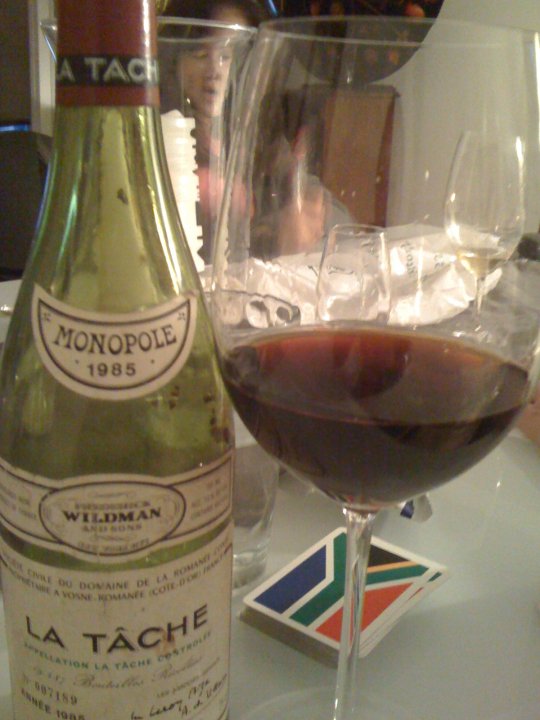
Wednesday, 26 January 2011

Sunday, 23 January 2011
2001 Brunellos in Westport, Connecticut
On Saturday night, Asher Rubinstein and his wife Deborah invited six ‘couples’ to his magnificent new house in Westport, CT, to try some 2001 Brunello di Montalcinos and a clutch of other 2001 Tuscans. They provided an inspired spread of cold cuts to accompany the wine. It’s been a while since I have focused on Brunello di Montalcino - mired in some controversy in recent years for not, in some cases, being true to its appellation - and especially not a horizontal.
Here are some brief impressions of the individual wines, and I will wind up with some general observations at the end:
- Caprili: Sophisticated and lively attack, decent fruit, no harsh tannins but fell away a bit at the finish
- Camiligliano: Smooth and velvety, smooth attack, chocolate-y notes but over easy
- Lisini: initially showed some nice structure, delicious wine and initially expressive then went soft on me
- L’Chiuse: Smooth refined chocolate-y nose, aggressive tannins on themid-palate, reasonable finish
- Altesino: Mellow attack, harsh aggressive tannins on the mid-palate, then not a lot
- Ciacci Piccolomini D’Aragona “Pianrosso:” Smooth attack, over-ripe, raisiny, over-cooked, little balancing acidity
- Livio Sasseti “Pertamali:” Alluring, sweaty horse saddle attack, some alluring blackberry kirsch notes on the mid-plate, one of the better wines, but still too easy and low in acid
Super-Tuscans:
- Montevertine: That’s more like it; lot going on here with some fab animal gamey notes, nice and complex, not taut at all but the best balanced wine and easily wine of the night.
- Felsina Rancia Chianti Classico – not a S-T but a bit anonymous
- Felsina Fontalloro – off-puttingly sweet attack, very much out of character with this wine, but a much more serious mid-palate.
Conclusion: This was a fascinating insight into modern Brunellos and Tuscans. The wines are enjoyable to drink and are clearly enhanced by food. But the overall impression is that these wines lacked ‘typicite’; they lacked ‘grip’ and ‘tension’– like you would get, for example, with a ’95 Lamarche burgundy, or patting a cheetah’ s stomach (which I did in South Africa in 2006). Many of these wines were over-easy, unbalanced with insufficient acidity to balance the alcohol. I expected very different wines from the lauded 2001 vintage. Still it was a fascinating insight into a region that has been off my radar for a while. I suspect that Brunellos offer some of the poorest value for money these days, and why not stick to younger more vibrant Rossos? Salvioni’s 2007 springs to mind. But, still, many thanks to Asher and Deborah for a splendid first outing for the CWC (Connecticut Wine Circle); my – arguably harsh - evaluation of the wines should not be construed the wrong way. It really was a fun evening and I met some interesting people.
A conversation (part two)
Amid tightened security George W. Bush was the final speaker. Looking older, greyer and somewhat disheveled the former President came across as a larger-than-life caricature of his public persona. He clutched the microphone and vented his spleen. He had a lot to get off his chest in the potentially hostile New York environment where liberal commentators might be lurking in dark corners. When it came to controversial subjects – like water-boarding – he boomed into the microphone protesting that it was legal and that it was his job – his mission as President – to protect his citizens from evil-doers (but wisely he did not use that expression) – while at the same time studiously avoiding criticism of the current incumbent of the white house - though the implication and implied distinction was clear. His off-the-record and frank profanity- and slang-laden portrayal of his years as commander-in-chief - were fascinating as it provided a clearer glimpse into his inner psyche. His defense mechanism appears to be to act the clown and he had the audience of finance professionals in fits of laughter. We were laughing at his quips; we were laughing at his vernacular (laden with bar-room slang – “Ben Bernanke is this surreal world kinda dude”); we were laughing with him; but sadly, we were mainly laughing at him. Beneath the defiant exterior bravado he cut a sad and dejected figure, who perhaps really didn’t believe what he was saying, or was perhaps confused by it; or perhaps we was just coming to terms with the implications of many of his profound misjudgments as president. He didn’t miss the limelight – only the perks and the power as ‘commander in chief’ - but he was only really out there to flog his book, to re-write history as he saw it, or as he pretended to see it, but perhaps he really didn’t believe it. As if he realized that he was really just the puppet of the radical neo-cons all along. But otherwise his instincts would appear to be to crawl under a rock and hide there forever in the hope that history doesn’t judge him too harshly. Only time will tell. He spent much time talking about foreign policy issues across the globe from China, Japan, Korea, Iran, Iraq, Afghanistan, the rest of the Middle East, the other Americas, Africa, Putin’s Russia even his mate prime minister John Howard of Australia, Chirac of France and Merkel of Germany. Conspicuous by its absence was any mention of the so-called ‘special relationship’ with the UK and Tony (‘the poodle’) Blair – all that investment for nothing then. Now for his legacy: he and Laura are setting up a foundation, among other things to promote “freedom and democracy in the Middle East.” Is he fucking serious?
Thursday, 20 January 2011
A conversation with a former President and a former hedge fund manager (part one)
At a conference in New York City I was privileged to listen to one of the greatest hedge fund managers elucidate his thoughts and amused to hear one of the most controversial former presidents vent his spleen. The former President was George W. Bush and the hedge fund manager Stanley Druckenmiller, most famous for ‘breaking the Bank’ (of England) in September 1992.
Part one: Stanley Druckenmiller, former hedge fund manager
By way of introduction Druckenmiller has been managing money for 30 years and has never had a down (calendar) year despite plenty of volatility in his returns, and having been down as much as 18% ytd at various points in 1999 and 2000. Getting back to positive from -18% takes some doing, and in many years he has made 50-60%. We should be able to learn a lot from him and we did.
Druckenmiller seems to have all the attributes for being a successful hedge fund manager. As well as being charismatic and a commanding room presence, he is clearly very bright, he can articulate a vision, he can distil information and extract the most relevant facts and while he can flip his view he seems to be able to take a medium term perspective. He is not hung up with short term noise, and spurious and crappy risk management models, and he understands that your year can be made with a handful of good trades. That’s all you really need.
Yesterday he gave us some of his insights:
- We are in an extreme economic and policy environment and therefore the chance of policy errors leading to dislocations is high. This means potentially good opportunities for macro investors.
- Just as Paul Volcker was a radical, with a radical new policy (monetarism) to crush inflation Ben Bernanke is equally (and oppositely) radical in that he is determined to increase inflation/banish the risk of deflation with an equally radical policy of quantitative easing (QE). Druckenmiller bet on Volcker being successful in the early 80s when ten year bond yields were 14% (but short rates were 18% implying negative carry), and it would be equally unwise to bet against Bernanke succeedingeither. So bet on inflation not deflation. Likewise Reagan and Obama are polar opposites with the former deregulating the economy and the latter re-regulating it.
- Crises are more likely where people are not looking for them. Right now they are looking in Europe and China, and neither is likely to have a full-blown crisis this year.
- In China total debt to GDP is 130%; in the US it is 370%; he is therefore not worried about China blowing up.
- Europe is a banking system problem more than a sovereign problem; the end-game is likely to be 50% haircuts in Greece and 25% in Portugal and Ireland.
- The US is not Japan because Japan took so many years to address its banking system and the capital ratios declined from eight to five, whereas in the US the banks were recapitalized early.
- Sizing trades correctly is crucial. This is what he learned from Soros. Sometimes you are hot, sometimes you are cold. When you are hot you should size up aggressively, and vice-versa. If you are up a good amount late in the year you should go for it; that is why he had a lot of 50-60% years and quite a few single digit years.
- In 1992 Druckenmiller explained the short sterling trade to George Soros and he had approximately 100% of the fund in the trade (about $7bn). It was the perfect trade for the perfect storm because the UK and its housing market were sinking and Germany was straining at the least and their currencies were pegged at the wrong rate with German interest rates. Soros asked him what was he thinking having just one times the fund in the trade. He should have been much bigger in it.
- Diversification is over-rated. In fact it is a dirty word. You should put all your eggs in one basket and monitor carefully. That means you will get big draw downs from time to time.
- If you are going to panic, however, it is best to panic early. Modern risk management systems are very flawed and the crisis exposed many of them to be severely wanting. The best risk indication is the behavior of the p’n’l.
- Last year he wound down his hedge fund and will trade his family money from now more aggressively and less often.
In a nutshell what are the conclusions? A good hedge fund manager needs to be able to think and articulate a view clearly, and be able to extract the most relevant pieces of information when the ‘noise to signal ratio’ is ever on the increase. He needs to understand policy reaction functions and be able to identify potential dislocations at an early stage. Once he has identified opportunities he needs to time his trade (being early can be as bad as being wrong sometimes), identify location (less important in the scheme of things when you are playing for discrete moves) and importantly size positions correctly. Only having the right view and missing the trade is worse than not sizing up properly a high conviction idea. He should resist the strong temptation to over-trade; or to day trade or fall into the trap of reacting and being jerked around by what is essentially noise. Don’t run with the ‘risk-on, risk-off’ herd. Just a few big trades can make your year.
Friday, 14 January 2011
Wine of the week: Cloudy Bay Chardonnay 2007

You would expect this to be blah, and amid some guffaws it was a sumptuous bottle of chardonnay. No pretence to be burgundian (i.e., thankfully not falling between two stools); intense, mellow, smooth, good attack, smooth and long; a trifle low in acidity, but a lovely quaffer for under $30.
Friday, 7 January 2011
Wine of the week: Revello Barolo Giachini 2001

I broke my 2011 duck with this beauty last night with my spaghetti bolognese. Popped and poured this is delicious straight out the gate - most 2001s I have tried have been much more backward and reticent than this. In this respect it is more like a 2000. Delicious, thick, lush and moreish, and quite high in alcohol (14.5% ABV) but fortunately none of the lingering afterburn I get in some of the Pira barolos (the 2000 Pira is 15% ABV). It has mocha, chocolate and plummy notes allied to classic aromas of tar and roses. With SpagBol this is one of the best food and wine combos and sends the pleasure monitor spinning wildly. This wine is not cheap (about $60 from memory) but freakin' delicious.
Saturday, 1 January 2011
The Kinks

As the logo suggests the name may derive from ‘kinky boots.’ I have been following the Kinks since the late 1970s and they hail from Muswell Hill in North London not far from where I was born. In the 1960s, they conspicuously eschewed the rock’n’roll antics of their peers and their songs focused instead on the quirkiness of English lifestyle and culture. At the same time, they were noted for their audaciously androgynous attire (well before David Bowie arrived on the scene). In recent years, the band (which disbanded in 1996 after 32 years), have had some deserved recognition and were inducted in the rock’n’roll hall of fame in 1990. However, arguably lead singer and songwriter Ray Davies (b. 1944) is one of the most talented of all lyricists, right up there with Lennon and McCartney and one of the greatest living Englishmen. Ray’s younger brother Dave (b. 1947), the lead guitarist, was the other mainstay of the band and has recovered from a stroke in 2004. The original bassist Peter Quaife died in 2010 aged 66.
Here is an esoteric selection of 20 of my favourite Kinks songs. The list does not include their three most famous hits - You Really Got Me, Lola and Waterloo Sunset - and many other great songs. As much as with the Stones and the Beatles there really is an embarrassment of riches.
20) I Go To Sleep – just an early demo in October 1964 it was later covered by the Pretenders and others.
19) Mr Reporter – this is a 1966 demo and an attack on the pop press. It was released as a bonus track on the 2004 re-release of the 1966 album Face to Face.
18) This Time Tomorrow – from the 1970 album Lola vs. Powerman and the Moneygoround.
17) Property from the 1983 album State of Confusion a track which chronicles the sadness of divorce.
16) 20th Century Man – the opening track from the 1971 album Muswell Hillbillies. It is a rant against the modern world, which starts languidly and builds up angrily and relentlessly.
15) Live Life – from the 1978 album Misfits. By now the Kinks had transmogrified into a hard rock band, almost full circle from You Really Got Me. Some of it wasn’t pretty but this hard-hitting track song is a lucid commentary on the turmoil of the late 1970s.
14) Destroyer – from the 1981 album Give the People What They Want. This is a tongue-in-cheek hard rocker, which borrows unashamedly from Lola and All Day and All of the Night. It is about the paranoid ‘City boy’ who takes Lola (the transvestite) back to his place...
13) Til’ the End of the Day – an early hit which appeared on the 1965 album Kink Kontroversy
12) Set Me Free – along with the similarly fashioned So Tired of waiting For You another hauntingly beautiful early hit from 1965.
11) Shangri-La – from the 1969 Album Arthur (Or the Decline and Fall of the British Empire)...A seminal commentary on English society and another song that starts of sedately and then really picks up the tempo.
10) People Take Pictures of Each Other – the last track on the 1968 album Village Green Preservation Society, and a jolly little sing along.
9) Afternoon Tea – from the 1967 album Something Else by the Kinks. A catchy but sad song as Donna doesn’t turn up for her afternoon tea.
8) Lost and Found – from the 1986 album Think Visual. This showed that Davies could still write stirring songs in the 1980s.
7) Days – released in 1968 originally on the Village Green Preservation Society album – it is a lament about a long lost lover.
6) Victoria – the opening track on Arthur, which builds up tempo to a searing climax and is, at the same time, a wry commentary on the inherent contradictions between the drudgery of Victorian society and the paternalistic outreach of the British Empire.
5) All Day and All of the Night – the second Dave Davies power riff from 1964, which is even more brutal than the seminal You Really Got Me.
4) Autumn Almanac – a 1967 hit later added as a bonus track to Something Else by the Kinks. This is Ray Davies the commentator at his brilliant best.
3) Mr Pleasant – another brilliantly witty and satirical composition penned in 1966. This was also added as a bonus track to Something Else by the Kinks.
2) Celluloid Heroes – this is the live version recorded in Switzerland in 1979 for the One For the Road album. The original studio version was recorded in 1972 for the album Everybody’s in Showbiz. Both versions are inspirational and this song is one of Davies’s finest achievements.
1) Sunny Afternoon – Released in June 1966 and later added to the Face to Face album what can you say? It is quintessentially Ray Davies and the Kinks. This song is now deservedly recognised and popular in the 21st century (and nearly got dropped from this selection as a result).
Subscribe to:
Posts (Atom)